
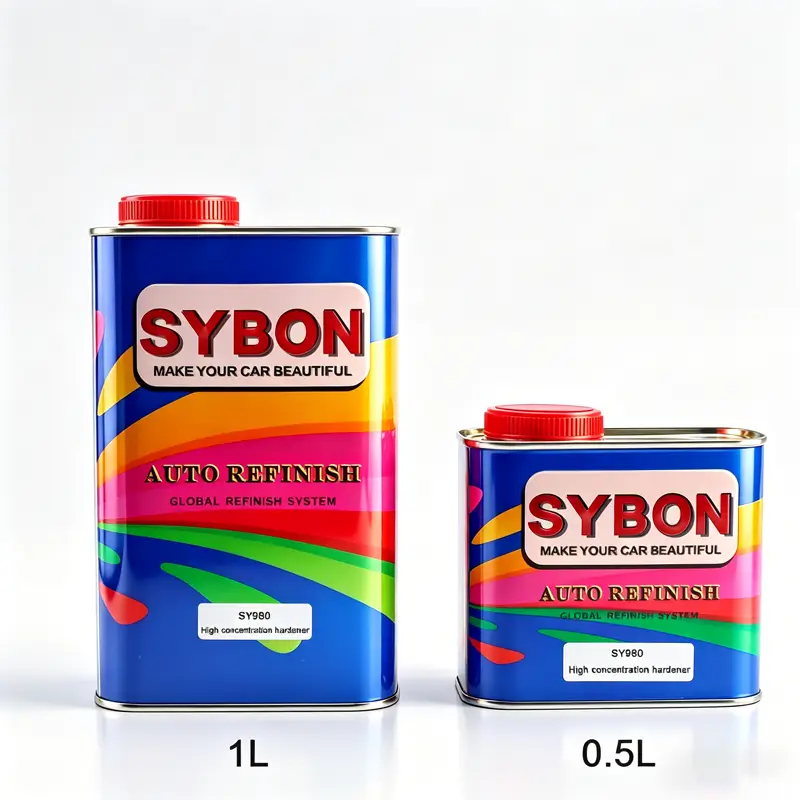
Hardener Gelling in Unopened Can: Why It Happens and What SYNEW Says About It
For import agents, wholesale distributors, fleet owners, and refinishing shops, a hardener is not just another consumable. It is a critical part of the 2K coating system, and once it fails, the whole paint job can be affected. One of the most frustrating problems is hardener gelling in unopened can. The package looks intact, the can has never been opened, yet when it is finally checked, the hardener has already turned thick, partly cured, or completely gelled. At that point, it can no longer perform its job in the coating system.
This issue is especially serious because hardener is very sensitive to moisture. Many users know that once hardener is exposed to water, it reacts immediately and begins to gel. The reason is chemical: water contains hydroxyl groups, written as —OH, while hardener contains isocyanate groups, written as —NCO. When these two groups meet, they react quickly and form polymers, which are high-molecular-weight compounds. In simple terms, the hardener starts curing inside the can instead of inside the paint film. Once that happens, the material is damaged and often cannot be used.
The Phenomenon of Hardener Gelling in an Unopened Can
Hardener gelling in unopened can usually appears in one of several ways. The product may look normal from the outside, but when the can is opened, the content is no longer smooth and liquid. It may have stringy lumps, a rubber-like texture, partial solidification, or a thickened gel-like body. In more severe cases, the whole can may be unusable.
This creates a serious problem for business users. Import agents may face customer complaints. Distributors may need to replace inventory. Fleet owners may suffer delays in maintenance schedules. Repair shops may lose time, money, and confidence from customers. Because hardener is a key component in 2K automotive paint systems, a failed hardener means the entire coating process can be disrupted.
Many people think that if a can has not been opened, the product inside must be safe. But with hardener, this is not always true. Even when the lid is not opened, moisture can still find a way to enter if the packaging is not perfectly sealed. That is why unopened can gelling is such a confusing and costly issue.
SYNEW’s Analysis of Why It Happens
According to SYNEW, the root cause of hardener gelling in unopened can is still connected to moisture, even if the can has never been opened. The first possibility is package leakage. Air always contains some amount of water vapor, even if we cannot see it. We can see fog or spring drizzle because the water content is large enough to be visible, but the tiny water molecules floating in the air are often invisible. Invisible does not mean absent. These small water molecules are always around us.
If the can is not fully sealed, these tiny water molecules can slowly enter the container over time. Once inside, they begin reacting with the hardener’s —NCO groups. This reaction gradually builds polymers inside the can, and the hardener begins to gel. At first the change may be small, but over time it becomes worse and can eventually make the product unusable.
The second possibility is moisture during production. Even if packaging is good, the manufacturing environment matters. If the air humidity is too high during production, moisture may already be present when the hardener is being filled and sealed. In that case, some of the hydroxyl groups from water vapor may react with the isocyanate groups before the product even reaches the customer. The reaction may be small at first, but it can still affect the curing performance of the coating. If the reaction is severe, the hardener may gel and fail completely.
That is why good manufacturers must produce hardener in a dry environment and strictly control humidity. This helps prevent moisture intrusion during mixing, filling, and sealing. Moisture control is not a minor detail. For a moisture-sensitive product like hardener, it is one of the most important parts of quality assurance.
Hardener Must React with the Right Partner
SYNEW also emphasizes an important point: hardener is not “bad” because it reacts easily. It is designed to react. The issue is whether it reacts with the right material.
In a 2K automotive paint system, the resin or base component contains many hydroxyl groups —OH. These groups need the hardener’s isocyanate groups —NCO to combine with them. That reaction is what allows the paint film to cure, harden, and reach its final performance. This is the correct chemical match.
Water is the wrong reaction partner. If water enters the hardener, the isocyanate groups react with moisture instead of the coating resin. This steals the hardener’s activity and causes gelling, poor curing, or complete failure. In other words, the hardener has found the wrong target.
Without hardener, two-component automotive paint cannot complete the curing process properly. It is like missing half of the system. That is why the condition of the hardener is so important for body shops, distributors, and refinishing professionals.
What Business Buyers Should Pay Attention To
For import agents and wholesalers, the most important thing is to choose a supplier that understands moisture-sensitive chemistry and packaging stability. For repair shops and fleet owners, storage conditions matter just as much. Hardener should be stored in a dry, cool, well-sealed environment, away from humidity and direct exposure to air. Once the seal is compromised, the risk of gelling increases quickly.
It is also important to inspect packaging quality, sealing performance, and shelf-life control. A low price is not enough if the product cannot stay stable in storage. For professional users, a failed hardener can cost far more than the original purchase price.
Why SYNEW
SYNEW is a leading Chinese automotive refinishing manufacturer trusted by agents and distributors who want both reasonable pricing and strong product quality. SYNEW offers one-stop purchasing service for automotive refinish products, making sourcing easier and more efficient for global partners.
Compared with big international brands, SYNEW may not have the same name recognition, but the product quality is comparable, while the cost performance is highly competitive. For buyers who want dependable quality without paying premium brand prices, SYNEW is a strong supplier choice. Our products are practical tools for entering local markets, winning customers, and improving business competitiveness.
SYNEW is actively looking for global agents and distributors. We are ready to cooperate with more partners and provide a full range of automotive refinish products for mutual growth and long-term success. If you are an importer, paint shop owner, car repair center owner, or distributor and are interested in becoming a partner, you are welcome to request samples for testing. Please contact us through our website and send us an email. We will get back to you within 24 hours.
Conclusion
Hardener gelling in unopened can is a moisture-related problem that cannot be ignored. Whether the cause is package leakage, humidity during production, or improper storage, the result is the same: the hardener reacts too early and loses its value. In automotive refinishing, controlling moisture is not optional. It is essential.
SYNEW believes that understanding the chemistry behind the problem is the first step to preventing it. When hardener is protected from moisture and paired with the right coating system, it can do what it is designed to do: help automotive paint cure properly and deliver durable, professional results.
Source of this article:https://www.synewchemical.com/
Get to know us through more channels:Youtube.